Google Ads for HVAC Companies: A Data-Driven Guide to Predictable Monthly Leads
With high-intent search clicks rising in cost and AI-driven search results reshaping top-of-page real estate, running profitable Google Ads for an HVAC business requires far more than basic keyword matching. It demands a full-funnel strategy built on precision targeting, AI Smart Bidding, and seamless CRM call tracking.
In this guide, we break down the exact data-driven PPC framework HomeRank Ads uses to help residential and commercial HVAC contractors generate a steady stream of high-margin installation and emergency repair calls.
We're not just aiming for traffic; we're aiming for conversions and a measurable return on your investment.
Contact HomeRank Ads to start converting with Google Ads for your HVAC company.
★ Key Takeaways
- Multi-Channel Coverage: Combine Google Local Services Ads (LSA) for pay-per-lead emergency calls with Google Search Ads for high-ticket system replacements.
- AI & Smart Bidding: Transition from manual CPC to Target CPA bidding to capture natural-language, conversational voice and search queries.
- Closed-Loop Offline Tracking: Connect Google Ads to your FSM/CRM (ServiceTitan, Jobber, Housecall Pro) to optimize campaigns based on real booked revenue, not just web clicks.
- Mobile-First Conversions: Send ad traffic to dedicated landing pages featuring click-to-call sticky banners, instant booking widgets, and clear financing offers.
- Negative Keyword Defense: Regularly filter out DIY, parts, and job-seeker searches to protect ad spend from wasted clicks.
1. 2026 HVAC Campaign Architecture: Comparing Channels
To dominate search engine results pages, HVAC contractors cannot rely solely on standard text ads. Capturing top-of-page visibility requires a balanced multi-channel approach across Google's advertising ecosystem:
| Campaign Type | Best For | Average CPL Range | Primary Intent Level |
|---|---|---|---|
|
Local Services Ads (LSA)
Displays Google Guaranteed badge at the very top of search results. You only pay when a qualified customer calls or messages directly. |
Emergency Repairs & Direct Phone Calls | $35 – $85 / lead | High (Pay-Per-Lead) |
|
Google Search Ads
Text ads triggered by specific keywords. Captures high-intent homeowners actively searching for quotes or solutions. |
System Replacements & High-Ticket Installs | $65 – $140 / lead | Very High (Immediate Need) |
|
Performance Max (PMax)
Automated, AI-driven campaigns running across Search, Maps, YouTube, Gmail, and Display from a single asset pool. |
Cross-Network Coverage & Local Awareness | $45 – $95 / lead | Medium - High |
|
YouTube & Display Retargeting
Serves visual ads and video clips to homeowners who previously visited your website but didn't book an appointment. |
Off-Season Tune-Ups & Brand Nurturing | $20 – $45 / click | Nurture / Retargeting |
Based on internal performance data across HomeRank Ads’ client campaigns, sending traffic to a generic homepage yields a weak 2.5% average conversion rate. Dedicated, mobile-optimized HVAC landing pages drive a 12%–18% conversion rate for Google Search Ads, while Google Local Services Ads (LSA) achieve 25%+ phone call conversion rates due to direct pay-per-call placement.
2. Keyword Intent in the AI Era: Emergency vs. Replacement
The foundation of a profitable HVAC ad strategy lies in segmenting high-margin replacement jobs from low-ticket repair queries.
Emergency Repair Keywords (High Urgency)
Emergency searchers want immediate service. Keywords like AC repair near me, furnace blowing cold air, or 24/7 HVAC technician require direct click-to-call ad extensions and rapid-response dispatching.
System Replacement & Install Keywords (High Value)
Homeowners evaluating full system upgrades search with intent queries like heat pump cost installation, best high-efficiency furnace installer, or ductless mini-split quotes. These campaigns should feature multi-option financing offers (e.g., "0% APR for 12 Months") and direct link-outs to instant online estimation tools.
Conversational & AI-Driven Search Terms
As voice search and Google AI Overviews expand, homeowners ask longer, natural-language questions. Combining broad match keywords with strict Smart Bidding allows Google’s machine learning to capture queries like "why is my central AC buzzing and not cooling the upstairs" while filtering out non-commercial DIY traffic through negative keyword lists.
Always pair high-intent broad match terms with a robust negative keyword list and Smart Bidding. This allows Google's AI to capture valuable long-tail queries without wasting ad spend on non-converting searches.
3. Geo-Targeting & Radius Precision
Wasted ad spend frequently occurs when ads show outside a contractor’s profitable dispatch area. Precision geo-targeting prevents budget burn.
Radius & Postal Code Filtering
Rather than targeting an entire metropolitan area, build concentric radius zones (e.g., 5 km, 15 km, and 25 km rings) around your service hubs. Apply bid adjustments or higher Target CPA goals to high-income postal code forward sortation areas (FSAs) where homeowners are more likely to approve full system replacements.
Exclusionary Targeting
Explicitly exclude adjacent municipalities, rural townships outside your service boundaries, and commercial zones if your business focuses strictly on residential service calls.
Target Monthly Budget Formula
Target Monthly Spend = Desired Booked Jobs × (Average CPL ÷ CSR Close Rate)
Example: To secure 10 new installs/month at a $120 CPL with a 50% CSR booking rate, your required ad spend is 10 × ($120 ÷ 0.50) = $2,400/month.
| Service Type | Average CPL Range (CAD / USD) | 2026 Campaign Notes |
|---|---|---|
| Emergency Repair (AC/Heating) | $45 – $95 CAD ($35 – $75 USD) |
High urgency; best captured via Google Local Services Ads (LSA) pay-per-call. |
| New System Install / Replacement | $90 – $180 CAD ($65 – $135 USD) |
High ticket value; requires dedicated landing pages with financing callouts. |
| Seasonal Maintenance / Tune-Up | $35 – $70 CAD ($25 – $50 USD) |
Low-cost entry offer used to build recurring service agreement membership routes. |
Note: These are illustrative benchmarks. Your actual CPL may vary based on competition, ad quality, and landing page effectiveness.
4. Bidding Strategies: Transitioning to Smart Bidding
Manual CPC and Enhanced CPC are obsolete for high-volume HVAC service accounts. Google's algorithms analyze thousands of contextual signals (location, device, search history, time of day) at the exact moment of a search.
Target CPA (Cost-Per-Acquisition)
Based on internal performance data across HomeRank Ads' client campaigns, transitioning accounts with 30+ monthly conversions from manual CPC to Target CPA bidding lowers average Cost-Per-Booked-Job by 18% to 27% within the first 60 days.
If your average allowable cost per booked lead is $75, setting a Target CPA gives Google the flexibility to bid aggressively on high-converting searches while stepping back on lower-intent traffic.
Offline Conversion Tracking (OCT)
Connecting Google Ads directly to field service management tools (like ServiceTitan, Jobber, or Housecall Pro) allows you to feed real revenue data back into Google. Bidding algorithms can then optimize for actual closed revenue rather than plain web clicks or general phone inquiries.
When transitioning to Target CPA, set your initial target 5%–10% above your actual historical CPL for the first 14 days. This gives Google's algorithm room to find winning signals without throttling impression volume during the learning phase.
5. Landing Pages: Converting Paid Clicks into Booked Calls
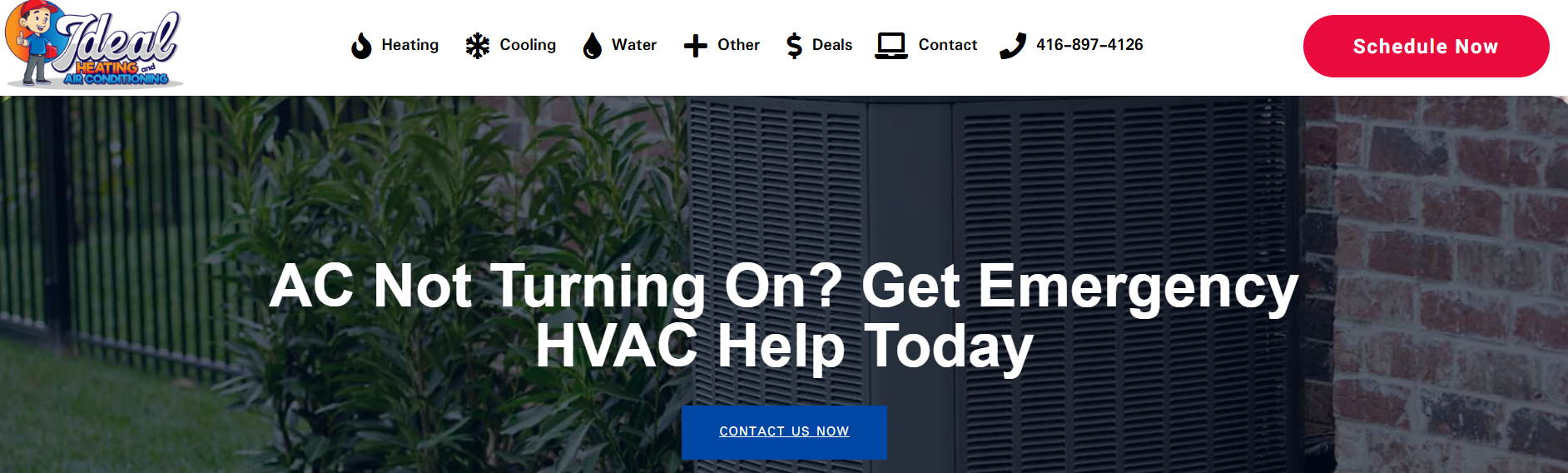
Courtesy: Ideal Heating
Sending paid Google Ads traffic to a standard homepage is a primary cause of low campaign ROI.
Data across our managed accounts confirms that adding a persistent click-to-call mobile banner and upfront financing callouts increases mobile lead submission rates by up to 34%.
Dedicated, mobile-optimized landing pages are critical for maximizing conversion rates.
Core Landing Page Elements
Click-to-Call Sticky Banner: A persistent phone call button at the top of mobile screens for instant emergency dialing.
Trust Signals & Certifications: Google Reviews badge, BBB rating, licensed/insured badges, and local technician photos.
Simple Booking Widget: An embedded calendar widget allowing homeowners to book service calls or quote consultations 24/7.
Upfront Financing Callouts: Clear mentions of monthly payment plans and promotional discounts (e.g., "$89 Season Tune-Up Special").
6. Negative Keyword Protection: Eliminating Waste
Negative keywords are your primary defense against non-profitable traffic.
Regularly review your Search Terms Report to add negative match rules for non-commercial queries.
🚫 Essential HVAC Negative Keyword Categories
Add these non-commercial term clusters to your campaign negative keyword lists to prevent ad spend waste:
jobs,
careers,
salary,
hiring,
apprenticeship
school,
training,
classes,
certification,
exam
how to fix,
DIY,
diagram,
youtube,
troubleshooting
free,
cheap,
used parts,
wholesale,
supply store
7. Scaling Your HVAC Lead Generation System
Once your search campaigns reach target profitability, expand lead volume using a structured scaling strategy:
Combine LSA + Search Ads: Double your SERP real estate by occupying both the Google Guaranteed top banner and the top text ad spot simultaneously.
Deploy Performance Max (PMax): Use visual asset groups (photos of branded vans, team photos, and customer install videos) to retarget site visitors across YouTube, Gmail, and Google Maps.
Budget Expansion Rule: When increasing campaign budgets, scale daily spend by no more than 15–20% every 5–7 days to keep Smart Bidding models stable.
Managing Google Ads while running an active HVAC company can quickly turn into a full-time job.
At HomeRank Ads, we build, manage, and optimize high-converting Google Ads systems built specifically for trade contractors and HVAC business owners.
Generate Predictable HVAC Leads With Google Ads
We provide the essential elements required to make your Google Ads truly profitable:
Website Design & Development: We build professional, conversion-focused websites that load fast and look flawless on any device, ensuring your expensive clicks turn into calls.
Google Ads Management: Our team handles everything from ad creation to budget allocation and bid adjustments, managing your campaigns for maximum ROI, not just clicks.
SEO Services & Local SEO: We optimize your site and Google Business Profile (GBP) so more customers can find your business organically, reducing your reliance on paid traffic.
Mobile Optimization: We ensure your site looks great and performs flawlessly across all devices, capturing the majority of high-intent search traffic.
Are you ready to stop leaking revenue and implement a tailored marketing strategy that drives real results?
Don't let another dollar of ad spend go to waste.
Contact HomeRank today for a personalized marketing plan that includes SEO, and Google Ads.