Building a High-Conversion HVAC Website
When your intent is building a high-conversion HVAC website, the #1 HomeRank Ads tip is simple: focus on user experience (UX). When visitors land on your site, they should instantly understand what you offer, trust your expertise, and feel guided toward taking action—whether that’s booking a service, requesting a quote, or scheduling a consultation.
This guide will show you how to improve user experience while also highlighting the other essential steps to building a high-conversion HVAC website.
1) The Steps To Take To Build a High-Converting HVAC Website
2) Keys to Building a High-Converting HVAC Website
3) The Importance of Your Home Page to Building a High-Converting HVAC Website
4) How to Build a Great HVAC Home Page
5) The Importance of Great Google Reviews
6) The Importance of Social Proof
7) The Importance of Strong Calls to Action
8) The Importance of a Great Menu and HVAC Service Pages
9) Why Is Having a High-Converting Website Important for Every HVAC Business?
10) What Does It Mean To Have a High-Converting Website?
By clicking the links above, you can explore each section in detail and learn how to increase leads and grow your HVAC business through your website.
If you have other questions or need a digital marketing company to help you with your online marketing, contact HomeRank Ads.
1) The Steps To Take To Build a High-Converting HVAC Website
The foundation of any high-conversion HVAC website is a seamless user experience combined with clear, action-oriented CTAs.
a) Focus on User Experience (UX) and Clear Calls-to-Action (CTAs)
The foundation of any high-conversion HVAC website is a seamless user experience combined with clear, action-oriented CTAs. Your site should be clean, intuitive, mobile-friendly, and fast-loading, allowing visitors to find services, pricing, and contact details within just a few clicks. Avoid clutter and confusing layouts, and instead guide visitors toward taking the next step.
Calls-to-action like “Book a Service,” “Request a Quote,” or “Call Now” should stand out and be easy to click. Place them strategically in high-visibility areas such as the site header, on every service page, and at the end of each page. Together, smooth navigation and well-placed CTAs create an experience that builds trust and consistently drives more leads for your HVAC business.
b) Optimize for Mobile Responsiveness
Many HVAC searches happen on the go, so your website must perform flawlessly on mobile devices. A mobile-friendly site loads quickly—ideally in under three seconds—and uses touch-friendly buttons that make it easy for visitors to call or book a service with a single tap.
c) Highlight Key Services and Value Propositions
Your HVAC website should dedicate separate pages to core services such as heating, cooling, ventilation, and maintenance. Each page should clearly explain what you offer and highlight your value propositions, whether it’s 24/7 emergency service, competitive pricing, or specialized expertise. Clear, concise language helps visitors immediately understand why they should choose your company over the competition.
d) Make Contact Information Easy to Access
Because HVAC customers often need service in urgent situations, contacting your business should be effortless. Place your phone number prominently in the header and footer, and ensure it’s clickable on mobile. Add a visible “Contact Us” form that requires minimal information so inquiries can be made quickly and without frustration.
e) Build Trust with Social Proof
Trust is one of the most powerful conversion tools. Display customer reviews, testimonials, and star ratings directly on your homepage and service pages. Reinforce credibility with logos or badges for certifications like licensed contractor status or Better Business Bureau accreditation. These trust signals reassure visitors that your company is reliable and professional.
f) Use Local SEO Strategies
Since HVAC services are highly location-specific, optimize your website for local search. Incorporate keywords such as “HVAC repair near me” or “AC installation [City]” into your content. Clearly list your service areas and integrate Google Maps so potential customers know you’re close by and available to help.
g) Implement a Booking System or Quote Tool
Streamline the path from browsing to booking with online tools. A simple scheduling feature or quote request form makes it easy for visitors to take the next step. Where possible, consider offering an instant quote calculator for specific services to give potential customers quick answers and encourage them to convert.
h) Include Visual Content and Educational Resources
High-quality images and videos showcasing your team, equipment, and completed projects add personality and professionalism to your site. A blog or resource section that answers common questions—like “How to Maintain Your HVAC System” or “Signs You Need Furnace Repair”—positions your company as a trusted authority while also boosting SEO.
i) Add Testimonials and Case Studies
Beyond simple reviews, dedicate a section to detailed testimonials and case studies. Share before-and-after photos or describe how you solved specific HVAC challenges for past clients. These stories help potential customers envision the benefits of working with you.
j) Incorporate Chat or Instant Support Features
Live chat and AI-powered chatbots provide immediate answers to customer questions, improving response times and guiding users through the booking process. Even after hours, automated chat tools can capture leads that might otherwise be lost.
k) Use Analytics and A/B Testing
Ongoing optimization is key to maintaining a high-conversion HVAC website. Tools like Google Analytics allow you to monitor traffic and behaviour, while A/B testing lets you experiment with different calls-to-action, colours, layouts, and headlines to see what resonates best with your audience.
l) Ensure Website Security and Fast Loading Speeds
A secure website is essential for building trust. Use HTTPS encryption across all pages to protect customer data. At the same time, optimize performance by compressing images, using efficient code, and investing in reliable hosting. A fast-loading site not only improves user experience but also boosts search engine rankings.
Does this sound like a lot? That’s why we recommend that you get the assistance of a digital marketing agency like Profitworks or HomeRank Ads.
2) Keys to Building a High-Converting HVAC Website
A high-converting HVAC website doesn’t just look professional—it’s strategically built to attract local customers and drive them to take action. While there are many factors to consider, three keys deserve special emphasis:
Integrate Localized SEO
Your website should be optimized for the specific communities you serve. Use geo-targeted keywords throughout your content—for example, “HVAC services in Ontario” or “air conditioning repair in Toronto.” Create blog posts and landing pages that speak directly to local concerns, such as seasonal HVAC maintenance tips or updates on regional rebate programs. Don’t forget to link your Google My Business profile to your site to boost visibility in local search results.
Ensure Fast Loading Speed and Mobile Optimization
HVAC customers are often searching in urgent situations, and if your site is slow or hard to navigate on mobile, they’ll move on. To avoid this, optimize images, streamline code, and use reliable hosting so your site loads in under three seconds. A responsive design will ensure your site looks and functions smoothly on any device, making it easier for customers to call, book, or request a quote on the spot.
Use Clear, Visible CTAs with Incentives
Visitors need to know exactly what step to take next. Prominent calls-to-action like “Request a Free Quote,” “Schedule an Inspection,” or “Call Now for 24/7 Emergency Service” should be placed above the fold and repeated across service pages. Adding urgency or incentives—such as “Save $50 on your first service call” or “Book today for priority scheduling”—can significantly improve response rates. Every page, video, and resource should guide users toward conversion.
Together, these three keys—localized SEO, speed and mobile optimization, and strong CTAs with incentives—form the backbone of a website that doesn’t just attract traffic but consistently turns visitors into paying customers.

Your Home Page is one of the most important pages on your site, and it’s your first impression. Make sure you include testimonials!
(Image Source: Ideal Heating & Air Conditioning)
3) The Importance of Your Home Page to Building a High-Converting HVAC Website
Your home page is the cornerstone of a high-converting HVAC website because it sets the first impression and guides visitors toward taking action. A clean, professional, and welcoming design immediately builds trust and positions your brand as reliable. If your home page feels outdated or cluttered, potential customers may leave before they even explore your services.
The layout should clearly communicate your core services, service areas, and unique value propositions. Visitors need to instantly understand what you offer, why you’re the best choice, and how they can get in touch. Clear navigation makes it easy to move from the home page to service pages or contact forms without confusion.
Strong calls-to-action also play a central role. Prominent buttons like “Schedule a Service” or “Get a Free Estimate” should be easy to find above the fold and repeated strategically throughout the page. These CTAs transform casual visitors into leads by making the next step obvious and accessible.
Your home page should also work hard for local SEO. Incorporating geo-specific keywords helps your site rank for searches in your service area, while consistent branding reinforces your expertise and local reputation.
Finally, build credibility by displaying trust factors directly on your home page. Customer reviews, certifications, warranties, and awards don’t need to be buried on an About Us page—placing them upfront reassures visitors that they’re dealing with a reputable, proven company.
In short, your home page is more than just a welcome mat—it’s a virtual storefront designed to invite visitors in, build trust, and convert them into paying customers.

As soon as you visit the home page, you can see the value of working with Profitworks: expert assistance in growing your business. (Image Source: Profitworks)
4) How to Build a Great HVAC Home Page
A great HVAC home page balances engaging design, clear messaging, and conversion-focused elements. Think of it as your online storefront: it should feel professional, answer core questions fast, and make it effortless to contact you or book a service.
Catch attention with a clean, professional design. Use a simple, uncluttered layout with clear navigation and consistent branding (logo, colours, fonts). Feature high-quality photos of your team, trucks, and finished work, and rotate seasonal visuals—air conditioning in summer, furnaces in winter—to signal relevance at a glance.
Communicate value immediately. Lead with a headline that states your promise (e.g., “Reliable HVAC Solutions for Comfort Year-Round”) and a clarifying subheadline (e.g., “Proudly serving Ontario with 24/7 emergency repair, maintenance, and installation”). Provide a brief overview of core services—heating, cooling, indoor air quality—so visitors instantly know they’re in the right place.
Use conversion-driven calls-to-action. Place a primary CTA above the fold—“Schedule a Free Estimate,” “Call Now for Emergency Repairs,” or “Book Service.” Repeat CTAs through the page and in the sticky header so they’re always one tap away. Use action verbs and benefit-driven microcopy (e.g., “Get a Quote—Response in 15 Minutes”).
Highlight trust-building elements. Surface Google review snippets or testimonials, plus badges for certifications (ENERGY STAR, NATE), warranties, and insurance. Keep your phone number visible and your address/local presence obvious—these cues lower anxiety and increase inquiries.
Optimize for local SEO. Weave location keywords naturally into copy (e.g., “Heating repairs in Mississauga”), list service areas, and embed a service-area map. Link to dedicated city/service pages, and keep NAP details (name, address, phone) consistent with your Business Profile.
Prioritize mobile performance. Make the page responsive, fast, and thumb-friendly. Compress images, limit heavy scripts, and keep navigation simple. Many HVAC searches happen on phones during urgent moments—slow or fiddly pages lose leads.
Add visual interest with purpose. A strong hero image or short background video can lift engagement. Use intuitive icons (snowflake for cooling, flame for heating) and include a small before-and-after gallery to showcase results. Remember descriptive alt text for accessibility and SEO.
Surface key information instantly. Keep the phone number in the header, list business hours and 24/7 availability, and include a short “Why Choose Us” block (e.g., upfront pricing, same-day service, certified techs). Minimize form fields so contacting you feels easy.
Use incentives to drive action. Promote timely offers like “$50 Off First Service” or “Free Indoor Air Quality Check,” and reinforce urgency with honest scarcity (e.g., “Limited-time spring tune-up pricing”).
Example home page structure (simple and effective):
Hero section: Headline, subheadline, primary CTA, and hero image/video.
Services overview: Short blurbs (heating, cooling, IAQ) linking to full pages.
Trust factors: Reviews, certifications, guarantees, and years in business.
Special offers: Current promos or seasonal deals with a CTA.
Service area: Map and list of cities/regions served.
Footer: Contact info, hours, social links, and quick links to key pages.
Follow this flow and you’ll create a home page that grabs attention, answers the right questions quickly, builds trust, and converts visitors into booked jobs.
Always showcase your reviews!
(Image Source: Google Reviews for Ideal Heating & Air Conditioning)
5) The Importance of Great Google Reviews

Great Google Reviews are essential for HVAC businesses because they build trust and credibility with potential customers. In a crowded and competitive market, reviews act as powerful social proof, reassuring people that your services are reliable, professional, and high-quality. A steady stream of positive feedback helps establish your reputation and makes prospects feel more confident choosing your company over another.
Google Reviews also play a direct role in improving your local SEO rankings. The more high-quality reviews you have, the more likely your business will appear in the coveted local “map pack” when people search for HVAC services in your area. This visibility puts you in front of customers at the exact moment they are ready to hire.
Beyond rankings, reviews can clearly differentiate your business from competitors. Comments that emphasize quick response times, excellent customer service, or fair pricing highlight your strengths in a way no ad copy can. By consistently encouraging satisfied customers to leave detailed reviews, you’ll boost your online reputation, attract more qualified leads, and convert more website visitors into paying clients.
For a deeper dive, see our dedicated post: The Power of Google Reviews For HVAC Businesses.
6) The Importance of Social Proof
Social proof is a powerful tool for influencing customer decisions, especially in industries like HVAC, where trust is critical. It refers to the psychological phenomenon where people look to others' actions or opinions to guide their own choices.
You can reassure potential clients that your services are reliable and high-quality by showcasing:
Positive testimonials
Online reviews
Case studies
Photos of happy customers or completed projects
Social proof is one of the most powerful tools for influencing customer decisions, especially in industries like HVAC, where trust is critical. It refers to the psychological tendency for people to look at the actions or opinions of others to guide their own choices. When potential clients see that others have had positive experiences with your company, they’re more likely to believe your services are reliable and high-quality.
You can showcase social proof in many ways, including testimonials from satisfied customers, online reviews, detailed case studies, or even photos of happy clients and completed projects. Each of these elements helps build credibility and reduces hesitation, giving new customers the confidence to choose your business over competitors.
To maximize its impact, highlight social proof consistently across all touchpoints. Feature it prominently on your website, display it on your Google Business Profile, and share it regularly on your social media platforms. The more often prospects encounter proof of your credibility, the stronger your reputation will become.
By making social proof a central part of your marketing, you’ll not only boost conversions but also strengthen your brand’s long-term reputation.
To learn more, read HVAC Social Proof and Case Studies as Sales Tools
7) The Importance of Strong Calls to Action
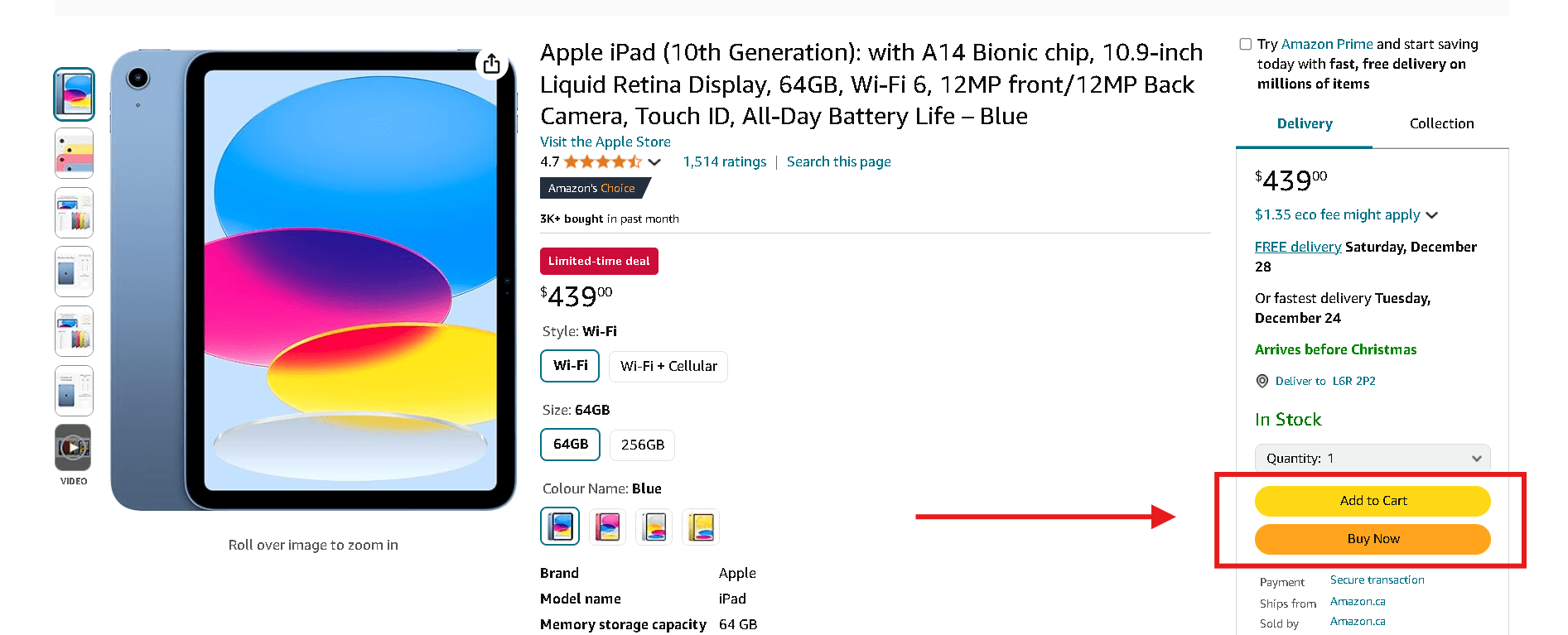
Wondering what CTA buttons look like? Here is an example of what Amazon uses to prompt you to purchase a product!
(Image Source: Amazon)
Strong calls-to-action (CTAs) are a cornerstone of any high-converting HVAC website because they guide visitors toward taking the next step. Whether it’s scheduling a service, requesting a quote, or calling for emergency repairs, CTAs remove uncertainty by clearly telling users what to do. Without them, even highly interested visitors may leave your site without engaging further.
Effective CTAs rely on clear, action-oriented language and often include a sense of urgency. Phrases like “Call Now for Same-Day Service” or “Book Your Free Estimate Today” not only tell visitors what to do but also encourage them to act immediately rather than delaying. Placement is just as important—CTAs should be highly visible, appearing above the fold, within service pages, and at the end of key sections to capture attention at the right moments.
By bridging the gap between user interest and actual engagement, strong CTAs transform your website from a digital brochure into a lead-generating tool. For HVAC companies, this can mean the difference between a lost visitor and a loyal customer.
Learn what to do and what NOT to do in your website’s navigation menu.
8) The Importance of a Great Menu and HVAC Service Pages
A well-designed menu and strong HVAC service pages are critical for creating a seamless user experience and driving conversions. Your menu functions as a roadmap, guiding visitors to the exact information they need—whether it’s details about heating repairs, AC installations, maintenance packages, pricing, or contact options. When navigation is clear and intuitive, potential customers stay engaged rather than leaving out of frustration.
Equally important are your service pages. Dedicated HVAC service pages give you the opportunity to highlight your expertise in specific areas, from furnace repairs and air conditioning installations to indoor air quality solutions. Each page should include detailed descriptions, explain the benefits of your services, and incorporate localized SEO keywords so you rank higher in search results for your target markets.
When your menu and service pages work together, your website becomes both user-friendly and informative. This combination not only helps visitors find what they’re looking for quickly but also positions your company as a trusted, professional choice. Ultimately, it’s these small but strategic details that turn casual website visitors into loyal, paying customers.

Amazon is one of the highest converting websites. Can you think of why?
(Image Source: Amazon)
9) Why Is Having a High-Converting Website Important for Every HVAC Business?
A high-converting website is essential for every HVAC business because it functions as your most powerful marketing and sales tool—working around the clock to attract, inform, and convert potential customers. In today’s digital age, most people begin their search for HVAC services online. If your website is built to convert, you’ll capture that traffic and turn it into qualified leads before competitors have the chance.
More than just an online brochure, a high-converting website actively builds trust. A professional design, clear messaging, and authentic customer testimonials reassure visitors that your business is reliable. Quick access to essential details such as service areas, contact information, and pricing makes it easy for users to get what they need without hesitation.
Strategically placed calls-to-action, whether for booking an appointment or requesting a quote, move visitors seamlessly from interest to action. The result is not only more leads and revenue but also greater efficiency in your marketing spend. By maximizing conversions, your website becomes a critical investment that drives long-term growth and ensures your HVAC business stays competitive in a crowded market.
Listen to Neil Patel talk about what makes a high-converting landing page for help building a high-conversion HVAC website.
10) What Does It Mean To Have a High-Converting Website?
At its core, a high-converting website is one that consistently turns visitors into leads, customers, or other desired actions—whether that’s booking a service call, requesting a quote, or signing up for a newsletter. It’s not just about attracting traffic; it’s about ensuring that traffic results in measurable business growth.
This is achieved through a combination of elements working together: clear and compelling calls-to-action, a user-friendly design, fast loading speeds, and content that speaks directly to your target audience’s needs. When these factors are in place, your website removes barriers, builds trust, and guides visitors naturally toward taking action.
High conversion rates are the clearest sign of a well-optimized site. They indicate that your website not only attracts the right visitors but also delivers the experience and information they need to confidently choose your HVAC business. In other words, a high-converting website isn’t just a digital presence—it’s a powerful engine for growth.

Building a high-conversion HVAC website can take time, but we can help. HomeRank Ads can help HVAC businesses turn their website into a high-converting platform by targeting highly specific, local audiences who are actively searching for HVAC services.
Through advanced keyword targeting and geo-targeting, HomeRank Ads ensure that the business appears in front of potential customers at the exact moment they need HVAC solutions.
By aligning with search intent, these ads increase traffic to the website from users who are more likely to convert, whether it's for a service appointment, quote request, or booking.
The ads are designed to drive qualified leads, ensuring that HVAC businesses not only attract visitors but also engage and convert them into loyal customers, optimizing the overall conversion rate of their website. Contact HomeRank Ads today and see your conversions improve!